
By Winnie Onu, Makurdi
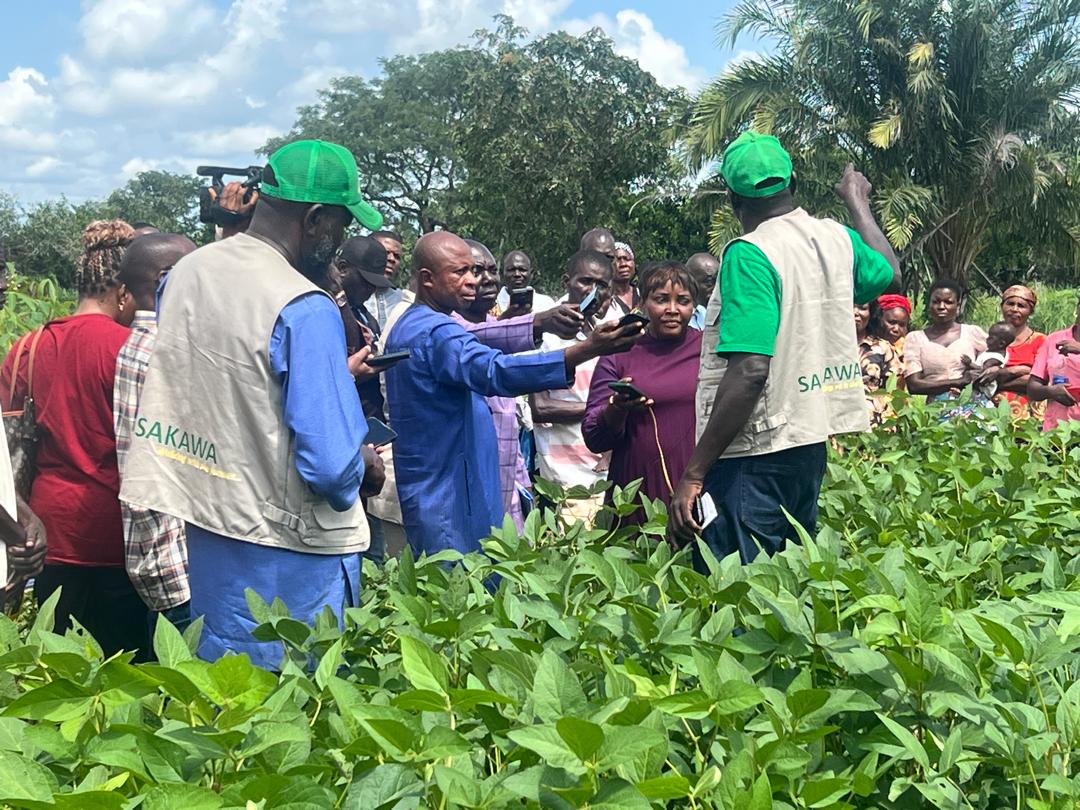
The Sasakawa Africa Association (SAA), has empowered 8,950 beneficiaries across eight local government areas in Benue State through integrated agricultural interventions aimed at shifting smallholder farmers from subsistence to commercial production.
The interventions, delivered under The Nippon Foundation, (TNF), project in partnership with the Benue State Ministry of Agriculture via the Benue State Bureau of Agricultural Development and Mechanization (BNARDA), focus on soybeans, maize, rice and horticultural crops.
Speaking in Cheedu community, Gwer East LGA, during the tour, SAA Program Officer for Safe, Adequate and Nutritious Food Systems, Dr. Engr. Moshood Sulaiman, said the Foundation established a solar-powered cassava processing center and borehole to address high production costs and water scarcity.
“We discovered that they produce a lot of cassava but they have to travel several kilometers to access equipment. So we established this center with a 5-ton per hour grater, two pressers and two 4×8 fryers,” he said.
“The borehole is solar-powered for 24/7 water access. We entrusted it to a community leader because giving such enterprises to a whole group to manage often creates problems,” he added.
Sulaiman intimated that SAA currently operates in Gwer-East, Gboko, Tarka, Guma, Ushongo, Vandeikya, Buruku, and Konshisha LGAs.
Also, a data released during the project tour on Monday, showed that SAA in 2025 mobilised and sensitized 1,366 farmers, and reached 8,950 farmers through step-down extension services.
Other achievements include the establishment of 1.5 hectares of CBSM seed multiplication plots involving 75 farmers, 1 Agro-Enterprise Processing Centre, APEC, 9 youth spray gang members empowered, and 58 participants in market linkage meetings.
Earlier, Jonathan Taknan Yasa, the Program Officer for Inclusive Markets and Agribusiness Development, said the core of the intervention is changing farmers’ mindset.
“We try to turn their mindset from farming as a way of life to farming as a business. We promote ‘produce to sell,’ meaning you have a ready market before going into production. As I speak to you, this group here already has a ready market for their garri. In fact, they don’t even meet the demand,” he stated.
Yasa added that SAA trained farmers on group dynamics and identified the Cheedu group as capable of running the processing center as a business, building on a previous project that promoted TME 419 cassava variety.
On his part, Moses Nongoatse, Communications Officer, said the interventions also help farmers cope with climate change effects like erratic rainfall and dry spells through the use of improved seeds.
Country Director, Dr. Godwin Atser, represented by Mr. Nathaniel Otene, said SAA’s work rests on three pillars: productivity and regenerative agriculture, safe and nutritious agri-food systems with emphasis on biofortification, and inclusive markets and agribusiness development.
“So we have a system that captures the entire value chain from production through enhancing nutrition and then ensuring there’s market for the farmers,” Otene said.
The Acting Director General of BNARDA, Mrs. Dooshima Zaki, described SAA’s work as “a huge asset” to Benue State, noting that it aligns with the state government’s passion for agriculture.
“This will amplify exactly what the Sasakawa team program is doing in the state… The state government is very passionate concerning agriculture, and it encompasses these three pillars you are working on,” she said.
Beneficiaries including Mrs. Mary Ukamave, Mr. Kwaghngu Aondofa, Zaki Atindi Tyom, and Mr. Ronald Aondoaver, who spoke in Gwer East and Gboko, expressed appreciation to Sasakawa.
They said that the new farming system introduced by SAA has made farming “better and profitable.”
