
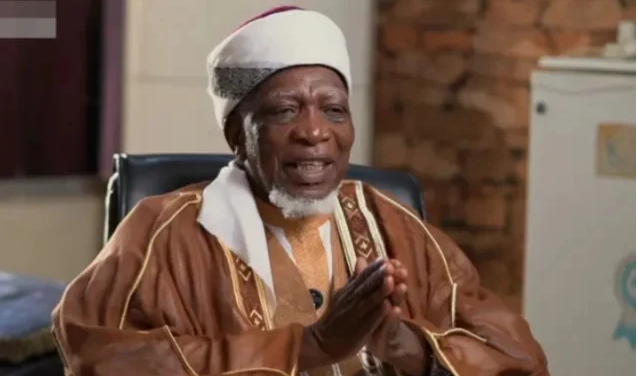
NIGERIA is never too far away from religious heat. For a while now, the description of Christians as “infidels” by Islamic cleric Sani Jingir, while canvassing support for a Muslim-Muslim presidential ticket ahead of the 2027 elections, fits into this increasingly unwholesome scenario.
Jingir’s comments are not merely inflammatory rhetoric carried too far, but are also an affront to the spirit of the 1999 Constitution, which guarantees freedom of religion and establishes a framework for religious neutrality by the Nigerian state.
After facing a backlash, Jingir has recanted: he loves Christians and wants President Bola Tinubu to be fair to them. That is an afterthought.
Religious leaders who preach hatred are the real infidels. They are enemies of Nigeria’s peace and unity and deserve the full weight of the law.
Tinubu stirred widespread controversy in the run-up to the 2023 elections when he contested on a Muslim-Muslim ticket. Four years later, he has repeated the gambit by retaining his deputy, Kashim Shettima.
A trending video circulating on social media showed Jingir making the controversial comments in Kano while addressing a political gathering organised by the Jama’atu Izalatil Bid’ah Wa Iqamatus Sunnah.
Drumming up support for the retention of the 2023 Muslim-Muslim presidential ticket by the ruling All Progressives Congress in 2027, the Islamic cleric said: “Special thanks to my (political) hero, Bola Tinubu, who raised the flag of this political ideology, describing it as a purely Muslim-Muslim coalition…I urge all of us here to go and get our voters’ cards ready. Let’s show the infidels their limit, who claim they are more populous than us in Nigeria. They are lying.”
This diatribe is nonsensical, narrow-minded and profoundly divisive. It reduces a complex political contest in a religiously diverse country to a crude contest between Muslims and “infidels” and, in the process, threatens the very social cohesion upon which Nigeria’s survival depends.
Jingir went further, unilaterally constituting himself as both a religious and political authority by telling anyone uncomfortable with the Muslim-Muslim ticket to leave Nigeria.
This is reckless and completely unacceptable. No cleric has the authority to determine who belongs in Nigeria.
Coming at a time when the dust over the renewal of the controversial Muslim-Muslim presidential ticket has yet to settle, and against the backdrop of the United States’ designation of Nigeria as a Country of Particular Concern over perceived persecution of Christians, Jingir’s comments are insensitive, irresponsible, crude, unpatriotic and unbecoming of a cleric.
Religious extremism persists in Nigeria partly because its promoters and perpetrators are too often treated with kid gloves.
For decades, extremists have spewed hatred, demonised other religions and denigrated fellow citizens with brazen impunity, while their organisations, traditional leaders and governments sometimes look the other way.
Such silence is dangerous. It creates the impression that inflammatory religious rhetoric carries no consequences.
Recently, another Muslim cleric, Shafy Adeba, reportedly said that Muslims reserve the right to fight and enslave non-Muslims and that waging war against non-Muslims is rooted in the Islamic religion.
Such claims, whether made from the pulpit or political platforms, should concern every responsible Nigerian.
Although a few notable Muslims and politicians have rejected Jingir’s “satanic” lines, media denials alone are not enough. What Nigeria needs is an unequivocal institutional response.
Rwanda should remain a permanent warning to societies that allow dehumanising rhetoric to flourish. The 1994 genocide was preceded by the systematic dehumanisation of Tutsis, including their description as “cockroaches.”
Words do not automatically produce violence, but history repeatedly shows that sustained demonisation can create the psychological and social conditions in which violence becomes easier to justify.
The government and religious leaders must learn from this and confront incendiary and blasphemous comments by misguided fundamentalists within their respective folds.
Countries that value religious harmony and societal cohesion jealously guard against attacks on one religion by another through strategic and deliberate pronouncements and actions. Nigeria cannot afford to be different.
In Indonesia, Muslim cleric Muhammad Waloni was charged with blasphemy in August 2021 for allegedly insulting Christians. Three days earlier, a Muslim-background Christian had been arrested for allegedly insulting Islam.
Nigeria must realise that religious provocation should not be tolerated selectively.
Religious organisations also have a responsibility to speak out whenever some of their leaders engage in extremist or hateful pronouncements. They must make it unmistakably clear that such individuals do not speak for the wider religious community.
The trouble is not with any religion but with leaders and adherents whose warped egos, ambitions and sentiments become larger than the religion they profess.
Worse than Jingir’s incendiary comments, however, was the apparent tacit approval of political leaders in his audience, including Kano State Governor Abba Yusuf and his Jigawa State counterpart, Umar Namadi, whom the video showed nodding and smiling. This is deeply disturbing. Political leaders cannot preach peace in public while appearing to endorse rhetoric that divides Nigerians along religious lines.
The failure of government, religious and traditional leaders to apply the law and rein in fanatics has contributed to religious violence and senseless killings on the streets, in secondary schools and on tertiary institution campuses. This is barbaric and cannot be allowed to continue.
Gideon Akaluka was beheaded in Kano in 1995 for allegedly desecrating the Koran.
In 2007, students of a secondary school in Gombe lynched their teacher, Oluwatoyin Oluwasesin, who had prevented them from carrying out a cheating-related act, after she was falsely accused of desecrating the Koran.
In May 2022, Deborah Yakubu, a 200-level student of Shehu Shagari College of Education, Sokoto, was stoned to death and her corpse set ablaze after she was accused of blaspheming against Islam.
In 2004, Sunday Achi, a Christian student of Abubakar Tafawa Balewa University, Bauchi State, was strangled to death by fanatical colleagues.
In 2009, Grace Ushang, a corps member, was raped and murdered in Borno State reportedly over her wearing the statutory NYSC trousers.
Eunice Olawale, an evangelist, was butchered in Kubwa, Abuja, for engaging in early-morning preaching.
Media reports also say more than 4,000 people were killed in the Sharia riots in northern Nigeria in 2000. Fanatics reportedly killed more than 250 people while protesting the Miss World Beauty Pageant, which was scheduled to be held in Kaduna that year.
Sadly, the culture of impunity persists, with perpetrators too often escaping prosecution. This is a dangerous incentive for extremists and a betrayal of the victims.
In hindsight, there is no way one religion can assume a superior position in a secular state without tearing that state apart.
Nigeria is home to thousands of Muslim-Christian marriages, demonstrating that ordinary Nigerians have long understood something that some religious extremists appear determined to forget: coexistence is possible.
Tinubu is a Muslim, while his wife, Oluremi, is a Christian. Is Jingir therefore suggesting that Nigeria’s First Lady is an “infidel” and should be banished? Where would such a warped logic leave the millions of Nigerian families in which Muslims and Christians live under the same roof?
The 1993 presidential election, in which Nigerians voted massively for a Muslim-Muslim ticket, and the countless Muslim-Christian marriages across the country are proof that Nigerians can choose political arrangements and personal relationships without allowing religion to become a weapon against fellow citizens.
The Christian Association of Nigeria has, as expected, rejected the labelling of Christians as “infidels” in unmistakable terms. But while Nigerians continue to demonstrate remarkable patience, patience has its limits.
Clerics, by their calling, are moral guardians and agents of peace and unity. They are expected to preach spirituality and morality among their adherents; to build love and unity; and to provide hope, forgiveness and peaceful coexistence at all times.
They must not turn the pulpit into a political war room or the mosque into a platform for demonising fellow citizens.
The security and peace of Nigeria are the platforms upon which every religion rests. There must first be a country before there can be a flourishing religious community. The country provides the enabling environment for the practice of religion and prescribes the legal framework within which that practice must take place.
Clerics who make divisive pronouncements are therefore spiritual leaders of particular concern. Their words can be more lethal than physical arsenals.
Boko Haram terrorists may use guns and explosives to pursue their madness, but extremist clerics can help create the climate in which such madness flourishes by lighting the match with reckless and satanic pronouncements.
That is why Nigerians, and especially the government, must put them in check.
Freedom of religion does not mean freedom to incite hatred. Freedom of speech does not confer a licence to threaten the peace or denigrate fellow citizens. And political ambition does not justify turning Nigeria’s religious diversity into an instrument of mobilisation and division.
The mosque and church should be sanctuaries of peace, not recruitment grounds for division. Nigeria needs clerics who heal its wounds, not preachers who deepen them.
PUNCH Editorial, August 25, 2026
