
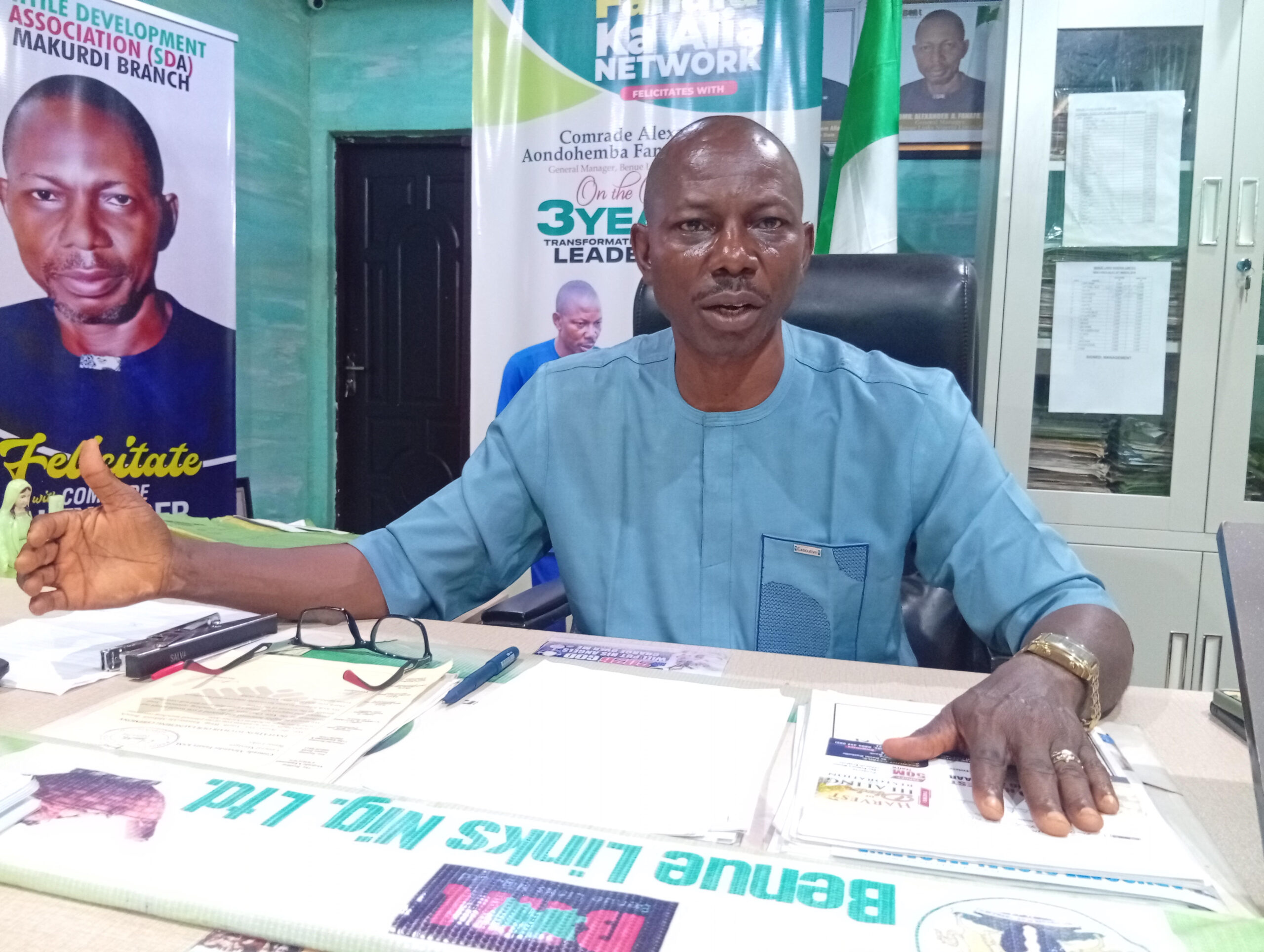
The Benue Links Nigeria Limited has undergone significant changes in its operations, fleet capacity and service delivery since the administration of Governor Hyacinth Alia appointed Alexander Fanafa as its Acting General Manager on June 15, 2023. From inheriting a company with only 13 functional government-owned vehicles, salary arrears and deteriorating infrastructure, the management says it has expanded its operations to nearly all local government areas in Benue State and several destinations across the country.
In this interview, the General Manager, Fanafa speaks on the company’s transformation, fleet expansion, passenger traffic, human trafficking intervention, security measures among other plans to include expanding its haulage services.
By Winnie Onu, Makurdi
What significant changes have taken place in Benue Links during your tenure over the past few years?
I assumed office on June 15, 2023, as Acting General Manager and served in that capacity for almost a year before my appointment was confirmed in 2024. I came in shortly after His Excellency, the Governor of Benue State, Rev. Fr. Hyacinth Alia, was inaugurated, and I was among his earliest appointees. The governor gave me the responsibility with a clear and strict instruction: to explore every possibility of improving the fortunes of the transport company. I inherited a company facing numerous challenges, including inadequate vehicles for fleet operations, a deplorable working environment and outstanding staff salary arrears, among several other problems. The governor invited us to brief him on the challenges confronting the company. I presented the situation to His Excellency, and he immediately began addressing the problems.
He started by tackling the deplorable condition of the company’s premises. He constructed a bus culvert to address the perennial flooding within the premises and provided a drainage system.
Previously, whenever it rained, the entire premises were severely flooded. The governor also ensured that the environment was improved through the interlocking of a reasonable portion of the premises and the completion of asphalt work. Canopies were equally installed to provide shelter for passengers during both rainy and sunny weather.
The objective was to make the premises more comfortable and provide passengers with a decent environment while waiting to travel. His Excellency did not stop there. When we came in, we had only 13 functional government-owned vehicles, while the company depended substantially on privately owned vehicles operating under its partnership arrangement. The governor injected 100 brand-new vehicles into the company to enable it to return to normal operations. He also provided trucks to enable us to introduce haulage services, which we have successfully commenced. Since then, we have continued to use the 100 buses and expand our fleet capacity, thereby extending our operational coverage. When we assumed office, we operated in fewer than 10 local government headquarters. Today, we have expanded our services to almost all the 23 local government headquarters in Benue State. But for security challenges, which remain a limitation in some areas, including Naka, I would have said we have extended our operations to all the local government headquarters.
Beyond this, we now move to virtually every nook and cranny of Benue State. We have also expanded our operations beyond Benue State. Previously, we had about 18 to 20 outstations in other parts of the country. We have now extended our reach to nearly 32 states, including the Federal Capital Territory, Abuja.
We now travel to Maiduguri, Sokoto, Zamfara and Katsina, among other destinations.
For instance, during the current mobilisation of prospective corps members to orientation camps, we arranged vehicles to transport them to their destinations across the country. We conveyed them to 35 states of the federation, including Abuja. This was not happening in the company in the past. It is part of the governor’s directive to ensure that prospective corps members travelling for their national service through Benue Links reach their destinations safely and are not abandoned halfway through their journeys.
Another significant achievement is the provision of permanent sites for the company. When we came in, the company’s assets had been depleted. However, His Excellency graciously acquired permanent sites for us in Abuja, High Level, Ihugh, Adikpo and Zaki Biam.
The sites in Ihugh, Adikpo and Zaki Biam have been developed and are being put to use, while we have also occupied a reasonable portion of our property in Abuja.
Within this period, we have developed our haulage business and established a solid operational structure for it. We have also registered with the Nigerian Postal Service (NIPOST) and obtained the necessary authorisation to operate courier services across the country. We have maintained our certification by renewing it annually and have been operating legally.
Furthermore, the governor directed us to revive the filling station within the company’s premises, which had been completely moribund.
The facility has been revived to make fuel readily available to our vehicles before they embark on their journeys. This reduces delays and improves operational efficiency. Once a vehicle is loaded with passengers, it can be fuelled within the premises and proceed on its journey without wasting time searching for fuel elsewhere. We have also introduced technological innovations because any organisation that fails to embrace technology risks being left behind. We introduced online booking, which is operating smoothly. Passengers can now book their journeys from the comfort of their homes or offices through our website, provided they have internet access. For about two and a half years, we have operated the online booking platform without any reported hacking incident. We developed the platform and are managing it with our own staff, demonstrating the company’s growing technological capacity and commitment to modern transport services.
We have also introduced Point-of-Sale (POS) payment systems at our stations across the country, including Benue State. Passengers can now pay with their ATM cards without incurring additional charges from the company. These are some of the improvements we have made. During this period, we also revived our Marcopolo buses, which had been abandoned and left in a state of disrepair. They have been refurbished and returned to the roads to provide transport services within Makurdi metropolis. We have equally introduced intervention services for commuters travelling from Makurdi to the University of Agriculture, now Joseph Sarwuan Tarka University, Makurdi. Students travelling to the university now have Benue Links buses available to them. We operate from Makurdi town through the Air Force Base, Apir and George Akume Way to provide affordable transportation. The aim is to provide an alternative for students and other residents who cannot afford some of the commercial transport options, including tricycles. Basically, we inherited a company that had been abandoned, but Governor Hyacinth Alia has revived it, injected new life into its operations, improved its performance and enhanced the services we provide to the public. We also welcome feedback from passengers because it helps us identify areas where improvements are necessary to serve them better.
Another improvement is the installation of solar-powered lights throughout the company’s premises. When you visit the premises at night, you will find solar lights providing illumination, enabling passengers arriving late to move around in a well-lit environment rather than finding themselves in darkness.
In addition, we have introduced other categories of vehicles, including coaster buses and Toyota Corolla cars, to give passengers more options depending on their needs and preferences. We want to make different types of vehicles available so that passengers can choose the most suitable option for their journeys.
Despite these improvements, what challenges is the company still facing?
There are still several challenges, but we are gradually overcoming them. The governor has given the company so much attention that we would rather concentrate on improving our services than constantly complain about our challenges.
When we came in, we inherited outstanding obligations, including gratuities owed to retired staff. We have substantially reduced these arrears, bringing them close to the barest minimum. We also inherited salary arrears, but we have cleared them. Regarding outstanding gratuities, we have drastically reduced the liabilities. We have liquidated the entitlements of some retired staff whose payments were outstanding when we assumed office, while payments are being made progressively to those retiring under our administration.
Another positive development is the increase in the number of privately owned vehicles operating under our partnership arrangement. As a company, more vehicle owners are now bringing their vehicles to us for operation under the partnership scheme, in addition to our government-owned fleet. When we came in, we had fewer than 500 privately owned vehicles operating under the arrangement, which we now refer to as private partnership. Today, the number has increased to about 1,200.
This growth demonstrates that vehicle owners have confidence in the company and believe their investments are protected.
Consequently, more people are bringing their vehicles into the scheme, and passenger traffic at our parks has increased considerably. However, the increasing number of passengers means that we need even more vehicles. Like Oliver Twist, we are asking for more vehicles to meet the growing demand and sustain our operations.
What other incentives does passengers of Benue Links enjoy?
The governor has also directed us to reduce transport fares to the barest minimum. Our priority is not to maximise profits but to break even while providing affordable transportation to Nigerians.
Furthermore, the governor directed that passengers living with disabilities should enjoy a 50 per cent discount on the already reduced fares.
Therefore, whenever a person living with a disability boards a Benue Links vehicle, that passenger is entitled to pay only half of the applicable fare, courtesy of the governor of Benue State.
The governor earlier directed the company to assist in returning trafficked persons to their communities. How many victims have you brought back so far?
Human trafficking is becoming increasingly common, and the governor has directed us to assist in returning victims to their communities and reconnecting them with their families. Whenever law enforcement agencies, including the National Agency for the Prohibition of Trafficking in Persons (NAPTIP), the police, the Department of State Services (DSS) and other security agencies, recover victims, we provide transportation to help reunite them with their families.
Community members who assist in rescuing victims can also bring them to our attention for assistance, once their circumstances have been properly established. So far, as of our last count, we have brought back 237 victims from different locations, including Lagos, Ibadan, Benin, Abeokuta and Ilorin, to Benue State.
When some of these victims return, Her Royal Majesty, the wife of the Tor Tiv, Professor James Ortese Iorzua Ayatse, receives some of them at her palace. She speaks with them, helps them overcome their trauma and supports efforts to rehabilitate and empower them. Some are referred for training and other forms of assistance to enable them to rebuild their lives. Many victims are deceived into believing that they are travelling elsewhere to find better opportunities. They may be promised jobs in restaurants, boutiques, companies and other establishments. However, upon arriving at their destinations, some discover that the promises were false. Their phones may be taken away, and they may be subjected to exploitation and other forms of abuse. Some eventually escape with assistance from others and return home to explain their experiences. The wife of the Tor Tiv has demonstrated concern for these victims, particularly young girls, by helping them recover from their experiences and supporting their reintegration into society.
Benue Links vehicles have previously been attacked on the roads because of insecurity, particularly during night journeys. What measures have you put in place to protect your vehicles, drivers and passengers?
We are a transport company, and we are not in control of the country’s security architecture. However, we work in synergy with relevant security agencies, including the Nigeria Police Force, the military, the Nigeria Security and Civil Defence Corps and the DSS. These agencies have been cooperating with us. When we observed that attacks were occurring mainly at night, we reduced our night operations and adjusted our schedules accordingly. Where security intelligence reports indicate that certain areas are unsafe, we avoid those routes at night. Our drivers are instructed to seek safe locations, such as military or police checkpoints and other recognised secure areas, where they can park and continue their journeys during the day. These are some of the measures we have introduced to ensure that passengers travelling from Makurdi or other parts of the country reach their destinations safely.
There are additional security measures that we cannot disclose publicly because doing so could give criminals information they might exploit.
We have established operational cooperation with security agencies, which monitor the movement of our vehicles and assist us when necessary. For instance, when a protest recently disrupted movement in the Tyomu community over the reported abduction of residents, security agencies mobilised and restored access to the road. Normal vehicular movement resumed in less than an hour.
We sincerely appreciate the police, the army, the Air Force, the Navy, the Civil Defence Corps and other security agencies for their support.
On another occasion, when some of our passengers were abducted, vigilante groups also mobilised to assist in their rescue. A number of suspected kidnappers were arrested and handed over to the police, who are handling the case.These collaborative efforts have contributed to the reduction in attacks involving our vehicles.
What is the situation regarding speed-limiting devices in Benue Links vehicles?
We have engaged a technician who specialises in speed-limiting devices. Every government-owned vehicle has a speed-limiting device installed. Privately owned vehicles operating under our partnership arrangement must also install these devices before they can be registered with the company. Our technician periodically checks the devices to ensure that drivers have not disconnected or tampered with them to exceed the approved speed limits. We are committed to ensuring that our vehicles operate within the prescribed speed limits. The Federal Road Safety Corps (FRSC) has also been very cooperative. Its officials visit our premises periodically to educate our drivers, conduct training and provide recertification.
In October, we had another major training programme for our drivers and staff. It was designed to cover road safety, security awareness and other relevant issues. We are approaching the busy end-of-year travel period, when many people are in a hurry and traffic volumes increase. We are also preparing for the heightened activities associated with the forthcoming election period.
We therefore want to sensitise our drivers and staff to remain vigilant, observe safety rules and be conscious of potential security threats. We have also received security briefings from personnel of the DSS, the military and Operation Whirl Stroke, among others.
We appreciate the leadership of the FRSC Sector Command in Benue State for its continued support and cooperation.
What mechanisms have you introduced to monitor your vehicles on the highways and ensure that drivers treat passengers appropriately?
We have introduced a system for monitoring our vehicles while they are on the road.
Management and operational staff have access to the tracking platform, which enables them to monitor the movement of vehicles travelling to destinations such as Lagos and other parts of the country.
We periodically check their movements to ensure that drivers comply with operational requirements. In addition, we have introduced a passenger feedback mechanism. Each vehicle has a sticker displaying its specific vehicle identification number and the company’s contact details. Passengers can use the provided telephone contacts to report concerns or complaints about the services they receive. When a complaint is received, we investigate it and, where necessary, contact the driver to caution or discipline them. The identity of a passenger who submits a complaint is not disclosed unnecessarily. No driver has the right to shout at or mistreat a passenger. Benue Links is a company established to serve its customers, and we expect our staff to treat passengers with respect.
What is the current operational scope of your haulage services, and what are your plans for expanding the business?
The governor provided haulage vehicles to enable us to expand our operations and respond to the growing demand for the transportation of goods.
We are gradually expanding our capacity to serve more routes and customers.
Our trucks currently operate on routes including Lagos, Abuja and Calabar, depending on the availability of goods and customer bookings.
For example, one of our trucks may transport goods from Calabar to Benue, proceed to Lagos and then move to Abuja, depending on the available consignments. We advertise our planned movements to enable customers to know the routes our trucks will cover and make bookings accordingly.
This allows people with goods to arrange transportation with us and monitor the availability of our services. We are committed to expanding our operations so that more customers can benefit from our haulage services.
