
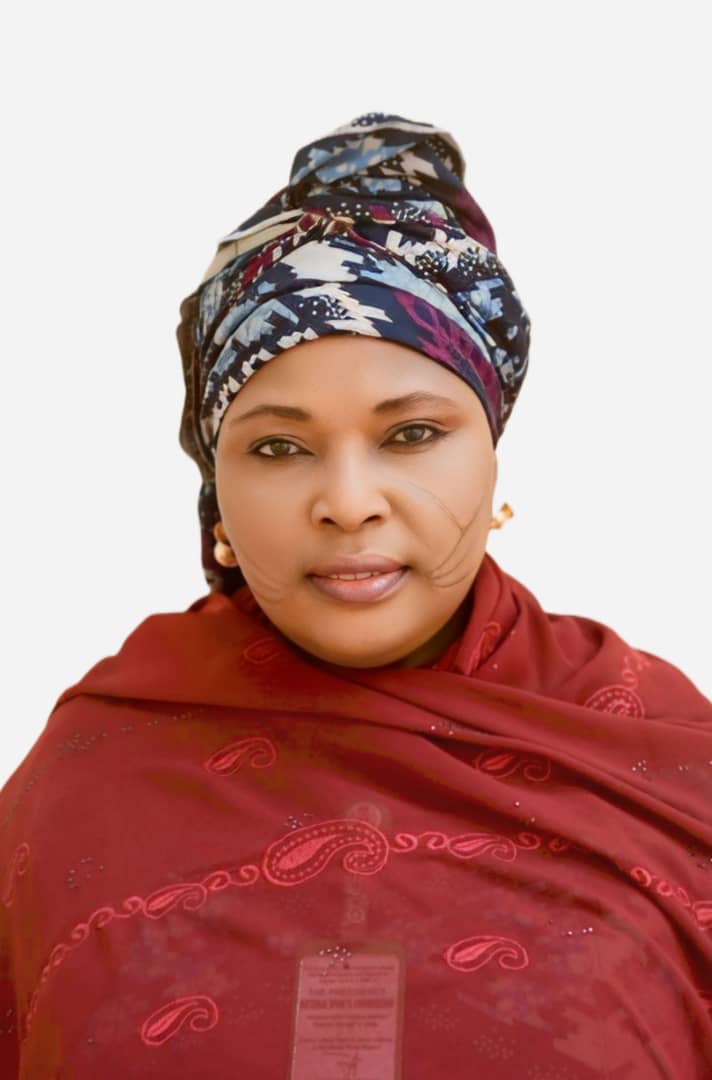
Hajiya Rekiya Ibrahim Amedu is the CEO/President of AAWDI Family Farmers for Food Sufficiency Initiative; a chartered accountant and farmer. In this interview with NIGERIA PROJECT, she shares her passion for farming and how the organisation has empowered a lot of people aimed at reducing poverty and providing food sufficient to the nation.
Chris Agada
How did you find yourself in farming as a chartered accountant?
I love farming with a passion. I lost my dad at my very young age, to be precisely age 4. I met my mum alone singlehandedly training many of us. In order for us to be properly fed and educated, we moved from one farmland to another to cultivate and sell. I was the closeness person to her among my siblings in the area of farming. I began to ask her while moving from one farmland and place to another. From farm land A to B – from Agojoeju my side to Ochadam. At Ochadam, we had plantain farm, while at Ochadam, we had sugarcanes, plantains and yam. My mother is from Agojoeju but my elder sister married at Ochadam, but Ofakaga was a nearby village where my patents settled; though my father is from Ejule. The community where my dad settled before he died, the community leaders asked my mother to continue with the farmland that my father was using before his demise, as a reward for his contributions to that community. My mother continued farming and the proceeds from those farming activities were being used to pay our school fess.
When I saw all my mum was able to achieve through farming, I became more passionate about agriculture. The family was large but my mother was able to feed all of us and paid our school fees at the right time. Some of my siblings were from different women, and some people were living with us – it was an extended family. Despite the large size of the family, my mother through farming could be able to feed us and paid our school fees, she never failed anyone of us in that aspect, even once.
My mother was using different value chains and straggles in farming – when we cultivated cassava and during the harvest, if the market price was okay, she sold them directly. But when the price was not okay, she fried it and converted to garri before selling. She was so dynamics in the area of farming, despite the fact that she was not educated. We had about 9 frying pans for garri. I started to fry garri at age 10. After frying the garri, my mother would package them into bags, and took them to Kano for selling. When returning from Kano to our base at Ejule, she bought all what we needed home. That was when I began to see prosperity in agriculture from such young age. I told myself from then that anywhere and level I found myself in the future, I would continue to farm. That was actually how I fell in love with farming. I saw huge prosperity in farming from my young age – we were living well, eating well and lacked nothing.
Ordinarily, my entire family supposed to feel the impact of the death of my father, because he was not there to provide for the family; but through agriculture, we didn’t feel that because my mother stepped into farming to bridge the gap. We were eating fine, our school fees were being paid on time, and there was money to run home. Agribusiness is a very lucrative.
We had a palm tree farm at Ochadam. During harvest, we produced palm oil, from the kernel, we produced another products that was used to produce another oil, used for local soap called ‘solder’, it was a popular local soap in the olden days, used for washing – it was very solid, strong and durable. Apart from that, you talked about the broom. So, from palm tree alone, you have four different products; and, of course, all of them give you good money.
My elder sister later ventured into the business of the soap- making. She would buy the chemical and made the soap. So, all the entire villagers were coming to our house to by the soap. Since then, I picked interest in agriculture because early enough, I discovered fortunes in it through my mother. Since then I vowed that anywhere I go or any position I found myself, I would continue to deeply involved in farming. Agribusiness business is very lucrative, if our leaders can sit down to see the hidden treasures in it, things would turn around. I have travelled to several countries around the world, there was none of those countries I visited that I wouldn’t cultivate (farm), if I stayed more than 5 months. I could remember when I travelled out to one of the countries, I saw the way they were wasting their palm tree seed. I said no, these deeds are not for wasting. I thought them how to convert palm tree see to oil. They planted them like flowers, but they didn’t know how to make oil from it. I thought them how to do it, they tested it and enjoyed it. Saturdays and Sundays are ordinarily supposed to be my rest days, after my official engagement (8am-4pm or 5pm, Monday –Friday). But unfortunately, Saturday and Sundays are my busiest days. I go to farm, train people on practical agribusiness, and the outcome is massive.

Why the youths are no longer interested in farming, even those that studied agricultural-related course from our higher institutions of learning, dumped them after graduation; what is your take on that?
A lot of issues are involved. Many, including the youths, don’t know much about the hidden fortunes in agriculture. They are not properly educated on that – the awareness is very low. Even those that went to high institutions to study agricultural-related courses, are not thoroughly acquainted with the practical aspect of it. During our days, they didn’t teach you only theory but also involved in practical. But these days, it seems we do more of theoretical. Also, government needs to create an enabling environment to make agriculture not only productive but attractive.
But, the good news is that since it would be unwise to depend on government for all these things, we had gone into partnership with National Youths Service Corps (NYSC) headquarters in Abuja to train our youths on practical agribusiness; and it’s really yielding results. Even those that have finished their service years back, we are tracing and training them. The issue is not studying the course in the school, but practical application is the real deal – which is what AAWDI is doing. One thing is to study, and another thing entirely is application. That is the missing point, and that is what we are currently doing. If we really give our youths the needed orientation and hidden treasure in agribusiness, it will save the country from youths’ restiveness.
How was farming look like during the days of your mother and now?
Modern farming is technological, scientific and skill-based unlike that of my mother’s days that it was pure physical energy. For instance, people used to complain that poultry business is very expensive in the area of feeding, but we have come with workable solution. You can actually go into poultry business and make good money. We will teach you how to locally produce your feeds at very low cost. As you getting your chickens, get a piece of land, plant your corns, millets and sodium – where you have all these on your farm, you can venture into poultry business. We will teach you how to produce your feed by yourself and very nitrous to the chickens. In the area of antibiotics in case they’re sick, you don’t need to worry about that – we have solution, too. Get your pawpaw leaves, bitter leaves and ginger depending on what is disturbing them. If they are giving or seeing some unusual signs, you can get them antibiotic. But if you mix aforementioned items and put in their water, they wouldn’t fall sick at all, talk more of getting them antibiotics. Even fish, we have solution. I have 15,000 fishes in my pond and I travelled. Before returning, 10 of them were dead. Immediately I came back, I grounded pawpaw leaves and bitter leaves (I have grounding machines) in my farms. After grounding them, I left some particles for them to chew, I threw into their water and that was all.
Anyone that is going into livestock business, it’s advisable that they have their farm field to cultivate those things I earlier mentioned. If you do that, you can start the business and make good return. Gone are the days you spent a lot of money on feeding, which usually lead to minimal profit or total loss. All these I train people and they’re doing well in the business.

What is your agricultural NGO is all about?
Yes, AAWDI Family Farmers for Food Sufficiency Initiative is non-profit and nongovernmental organisation. I was doing this alone as a passion I have for agriculture as earlier explained. I was using my resources to empower people especially youths in the area of agriculture. My husband was also supportive, but it got to a point that the load became so much. A lot of people were calling me from here and there for one assistance or the other.
There was a time that hunger was much in the country, to the point that they were calling our country a hungry nation. That was what sparked my head, I said, no; my country can’t be a hungry nation. We’re so blessed with good land and abundance natural resources with human capital. Nigeria has given me so much, I came from nothing to write home background. I felt it was time for me to give back to my country; that was how the idea of this organisation came in. I looked for like-mind individuals, and today, our presence cuts across every nooks and crannies of this country. Our plan is to provide food and job for every Nigerian. Our country is so blessed with land, we have no business with hunger.
How are you getting funds to empower these people?
Our model is using cooperative money. We safe some little amount of monies there on monthly basis. That is only source of our income for now. In 2023, from the savings, we were able to give N30,000 naira each to 300 young Nigerians to get a piece of land for their farming. We provided the farm product seeds such as cassava stems and so on for them. Today, they are doing well and are the ones spreading the news. We gave them money for a piece of land, they planted cassava. Their total expenditure was put at N150,000; and during harvest, they made around N1.5m That year, cassava sold very well. If you deduct N150,000 from N1.5m, it was a good business. The challenge has been funds which is why we’re soliciting for government to support us in order to do more.
What is your advice to the government and the stakeholders?
My first advice goes to the communities themselves. They should organise the youths in their domains and arrange them in cluster (group). All the countries that I have travelled to, they don’t wait for their government. What the government usually do is creating enabling environment. Community leaders should organise themselves into cluster and form a cooperative. What I meant by cluster is this; cassava farmers should form their group, those that are involved in animal husbandry should arrange themselves and so on. If they group themselves, they can form a cooperative where they can begin to safe some monies there and begin to grow. It’s a team work because nobody succeeds alone. They can move further by registering with agriculture association like ours so that they can expand, get more training and opportunity. Our organisation just received a certificate of an approval by International Cooperation Department from Ministry of Budget & National Planning. If they register with us, we will teach them smart and modern ways of farming. It was unlike in the past that you need to use energy to farm. Modern farming doesn’t require energy. We’re in entire local governments of Nigeria. All they need to do is to ask for the name of our organisation, call or visit our website www.aawdi.ng. There is a link where they can register and become member. But at their own level, they can form cluster, cooperative and then link up with us.
My second advice is to community leaders. Let them identify what is having comparative advantage at their environment, and encourage those that are serious to get connected to it, so that people especially youths can be prosperous through agriculture.
To the government, I want to advice that they should take agriculture serious. We shouldn’t dump this God-given gift because of oil. Nobody eats oil but agriculture provides food for the people. I can see that this was the best gift of God to our country. Government should create an enabling environment for farming, and let them support farmers with inputs. Even if they are unable to give money to farmers, they should provide modern farming tools for them especially for mechanised farming. Farmers usually discourage if they can’t fully take their products to the end. For instance, those that plant cassava or maize should not only end at the harvest and sell to the first consumer alone.
Let the machines be available for them to move further by making animal feeds or bread cassava from such products. You now see that they make money from different streams of one product. That is what would keep them farming because they would make good money, and have food to not only feed themselves and family, but to the entire nation.
Let the government come to the aide of the farmers by providing an enabling environment, support them with inputs, and also, amend some relevant laws to make it easier for farmers to operate. Nigerians are not lazy people, if the stakeholders especially government gives the necessary support, the people will embrace agriculture. Not only will the problem of hunger or youths restiveness will be solved; it will also contribute to the GDP of the country.
